
How to Check Criminal History in St. Bernard Parish
Choose the channel by the question. The St. Bernard Parish Prison roster is the fast route for present local custody. The District Attorney's docket calendar helps locate scheduled hearings by name, date, or division. Full pleadings and certified dispositions come from the Clerk of Court, whose eSearch service requires an account and subscription. A person's own statewide identity record comes through Louisiana State Police BCII's fingerprint-based Right to Review.
Collect a full legal name, date of birth, spelling variants, and any known docket or booking number first. A name match alone is weak proof. Dates, aliases, court division, charge text, and disposition should agree before a result is treated as the same person.
- Check the parish jail roster for a recent booking or current custody.
- Use the DA calendar to identify a court date, division, and case reference.
- Ask the Clerk for the docket, charging paper, minutes, judgment, or certified disposition.
- Request the arrest or incident report from the Sheriff's Criminal Records Division when the event narrative is needed.
- Use a BCII Right to Review for a fingerprint-linked copy of your own Louisiana record.
For older activity, widen the search in stages. A release removes a person from the live jail roster but does not erase the booking, and a closed court case may remain available through the Clerk even when it no longer appears on a current DA calendar. If a name search fails, try a known alias or former surname and ask the custodian how older files are indexed. When two people share a name, use lawful identifiers and certified records instead of assuming that a date or charge belongs to either person. This measured approach reduces false matches and makes the final record easier to verify.
Keep the source date with each result. Records from different stages may be accurate at different times.
St. Bernard Parish Records Campus
The criminal case system centers on the courthouse at 1101 West St. Bernard Highway in Chalmette. The Thirty-Fourth Judicial District Court has five elected divisions, A through E. Clerk of Court Randy Nunez keeps filed criminal cases, while the District Attorney handles prosecution and publishes a narrower court-date calendar. Court and DA hours are listed as Monday through Friday, 8:30 a.m. to 4:30 p.m. The Clerk's main phone is 504-271-3434, and the DA's is 504-271-1658.
The Sheriff's administration is at #2 Courthouse Square, but detention records belong to St. Bernard Parish Prison at 1900 Paris Road. The DPS&C St. Bernard locality page confirms the prison and parish justice contacts.
The official DPS&C listing shows where parish custody records originate:
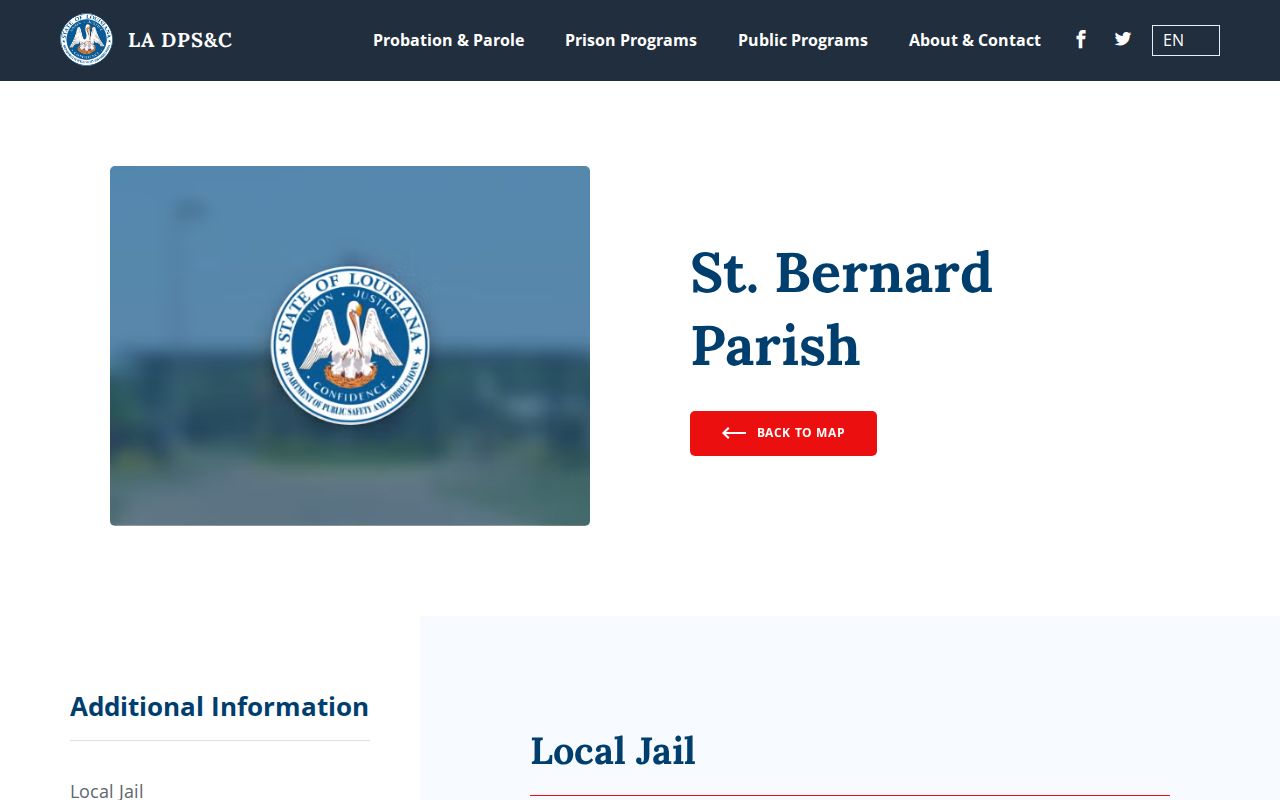
Keeping the courthouse, Sheriff's administration, and prison addresses separate prevents a report request from reaching the wrong counter.
Clerk of Court
1101 W. St. Bernard Hwy.
Chalmette, LA 70043
504-271-3434
Sheriff's Office
#2 Courthouse Square
Chalmette, LA 70043
504-278-7755
Parish Prison
1900 Paris Road
Chalmette, LA 70043
504-278-7650
Official Louisiana Background Checks
The Louisiana State Police Bureau of Criminal Identification and Information, or BCII, maintains the central state repository under R.S. 15:578. Its background-check hub links to the account-based Internet Background Check service, authorized disclosure forms, expungement resources, and the Right to Review process. Louisiana does not offer an unrestricted, low-cost public conviction name search like some states do.
For a complete copy of your own Louisiana criminal history, use the fingerprint-based Right to Review through the Louisiana Applicant Processing System. The live scheduler controls available digital fingerprint sites and hours; the research did not confirm a permanent LAPS site in St. Bernard Parish. A current authorization form lists $31 for a state check, including a $5 technology fee, but the selected purpose and any federal component can change the final price.
Route St. Bernard Record Requests
The St. Bernard Parish Government Complex accepts requests for parish administrative files, not criminal certificates or police reports. Its official public-records request page sends criminal certificate questions to the Clerk and police report requests to the Sheriff. That local warning matters because all three offices are public bodies, yet each controls a different record set.
The parish's online request instructions show this routing rule clearly:
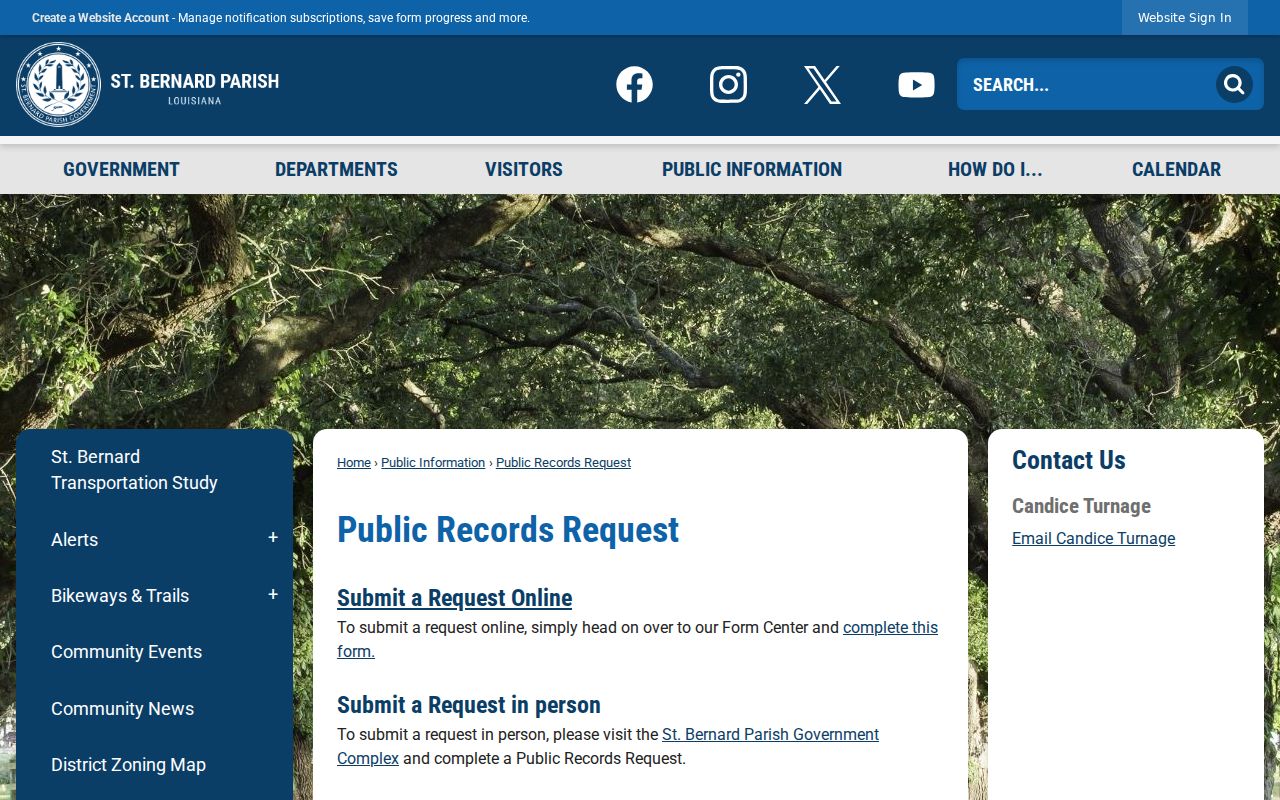
Send enough detail to identify the record, but do not ask one custodian to certify another office's work.
| Need | Start With | Record Produced |
|---|---|---|
| Police event details | SBSO Criminal Records Division | Incident, arrest, or accident report |
| Filed charge and outcome | St. Bernard Clerk of Court | Docket, minutes, judgment, certified disposition |
| Current local custody | St. Bernard Parish Prison roster | Booking and custody snapshot |
| Own statewide history | Louisiana State Police BCII | Fingerprint-based Right to Review |
Types of Criminal Records in St. Bernard Parish
An arrest creates related records, not one universal file. A deputy writes an event report, the prison records intake and custody, the prosecutor decides what charge to institute, and the Clerk preserves the court's action. Fingerprints help BCII tie that arrest cycle to later reported outcomes.
- Arrest and booking records show the reported event, intake date, initial charge, bond, and custody status.
- Criminal court case files contain the charging instrument, docket, motions, minutes, judgment, and sentence.
- Repository histories join fingerprint-linked Louisiana arrest cycles and reported dispositions.
- Warrants and capiases arise from judicial process, while operational execution details remain with law enforcement.
- Custody, supervision, and registry records are split among the parish prison, DPS&C, and BCII's public registry.
Read St. Bernard Case Terms
Short docket labels can change the meaning of a search result. An arraignment is the hearing where the accused hears the formal charge and enters a plea. A bill of information is a charging paper filed by the District Attorney where Louisiana procedure permits prosecution without a grand jury indictment. A nolle prosequi, often shortened to “nolle pros,” means the prosecutor stopped pursuing that charge at that time. It is not the same event as an acquittal after trial.
Bond data also needs context. Cash, surety, and release on recognizance describe different ways to secure a person's return to court. They do not state how the charge ended. Likewise, probation is a community sentence imposed by the court and administered through Louisiana DPS&C. Parole is conditional release from incarceration under the state parole structure. Read each term beside the date, count, and court minute that created it.
- Disposition
- The result of a charge, such as conviction, dismissal, acquittal, or nolle prosequi.
- Capias
- A court command for arrest, often issued after failure to appear or comply.
- Minute entry
- The Clerk's chronological record of an appearance, ruling, filing, or court action.
- Article 893 or 894 deferral
- A Louisiana process that may defer a qualifying judgment and permit later relief after conditions are met.
Sheriff Records and Mobile Access
The Sheriff's Criminal Records Division accepts incident, arrest, and accident report requests. Its form asks for the requester and mailing details, incident date, location, report or item number when known, involved names, report type, and signature. Mailed requests go to P.O. Box 168, Chalmette, LA 70044. The published schedule lists $15 for incident or arrest reports up to 15 pages, $1 for each added page, and $7.50 for an initial one-page accident report.
The official SBSO home page provides the agency's divisions, forms, and public notices:
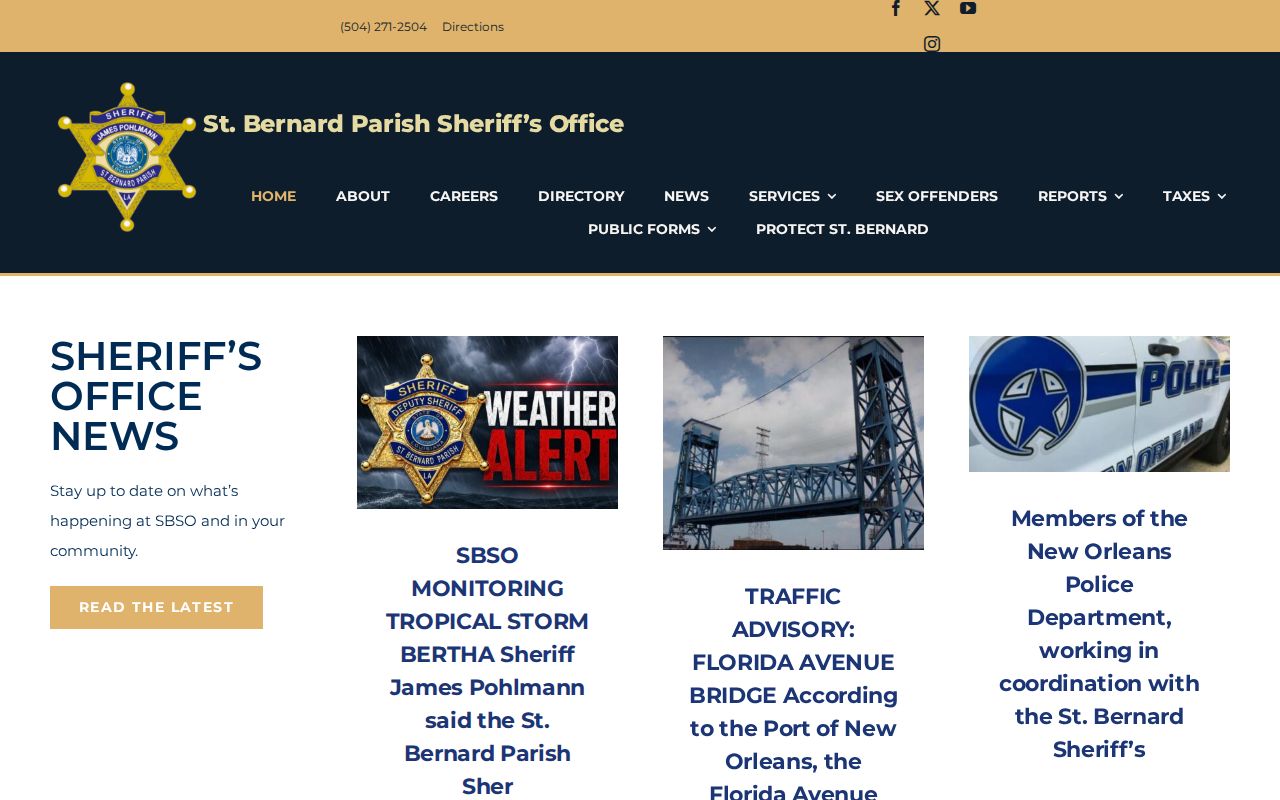
The official St. Bernard Parish Sheriff LA app also lists inmate search, warrants, alerts, and agency information. The app can add access when a web feature is hard to locate, but an app result remains a lead rather than a certified court outcome.
| Record Service | Published Fee |
|---|---|
| Incident or arrest report, up to 15 pages | $15.00 |
| Each page over 15 | $1.00 |
| Initial one-page accident report | $7.50 |
| Accident report added pages | $1.00 each |
What a St. Bernard Parish Criminal Record Shows
A Louisiana rap sheet is identity-centered, while a 34th JDC file is document-centered and a jail entry is custody-centered. Read the fields in that context. A booked offense is not the prosecutor's final charge, and neither is proof of conviction without a matching disposition.
| Name & Identifiers | Legal name, aliases, date of birth, sex, race, fingerprints, and state or FBI identifiers where authorized. |
|---|---|
| Arrest / Booking Data | Arrest date, agency, control number, initial offenses, booking date, bond, and custody status. |
| Charges & Statutes | Complaint, bill of information, or indictment with count and Louisiana law citation. |
| Disposition | Filed, amended, dismissed, nolle prosequi, acquitted, plea, or conviction outcome for each count. |
| Sentence | Custody term, probation, fine, restitution, and whether terms run together or one after another. |
| Custody / Supervision Status | Parish jail custody, state imprisonment, probation, parole, release, or transfer information. |
From Booking to Court Outcome
The records pipeline is: arrest report › parish booking › District Attorney charging decision › 34th JDC docket › judgment and sentence › disposition report to BCII. The free DA calendar is useful for dates and divisions, but it is not the full Clerk file. The Clerk's eSearch has broader case access behind a subscription, and the counter can supply certified copies.
A missing disposition on a repository record does not prove that a case remains open. Older paper records, delayed reporting, aliases, and unmatched control numbers can all cause gaps. Obtain the certified 34th JDC disposition first, then follow BCII's challenge instructions if your Right to Review remains wrong.
Verify St. Bernard Parish Warrants
No verified public parish warrant database was located during the official-source review. The Sheriff's official mobile app advertises a warrants feature, while its communications center can be reached at 504-271-2501. Court-issued capias information may also appear in the 34th JDC file or DA magistrate postings. These sources serve different roles: the court shows the judicial act, and the Sheriff controls live enforcement information.
Do not rely on an old screenshot, third-party people-search result, or a missing web entry to decide that a warrant is inactive. A person resolving their own possible warrant should contact the court or counsel before appearing at an office, because staff cannot promise what enforcement action will follow. The DA publishes current magistrate and Gwen's Law hearing notices, but those postings are not a complete warrant list. Certified docket material remains the sound source for the order itself.
Warrant caution: Only the issuing court and executing law-enforcement agency can confirm current status and the proper way to respond.
Public Access Laws for St. Bernard Parish Criminal Records
The Louisiana Public Records Law broadly reaches records of state, parish, and local public bodies, but access depends on the record and its status. Active investigative material, protected sources, juvenile information, victim details, and sealed files can be withheld. R.S. 15:548 permits broad dissemination of conviction information and current processing information while restricting many nonconviction repository records.
Key Statutes:
R.S. 44:1 defines Louisiana public records and custodians.
R.S. 44:3 covers key law-enforcement and investigative exceptions.
R.S. 15:548 controls criminal-history dissemination.
R.S. 15:578 authorizes BCII's central repository.
Why Chalmette Is the Hub
St. Bernard Parish has no incorporated municipalities. Chalmette is the parish seat and principal census-designated place, so the Sheriff, parish prison, 34th JDC, Clerk, District Attorney, and Parish Government hold the official channels that a city police department or municipal court might fill elsewhere. The Louisiana parish profile confirms the seat and local identity:
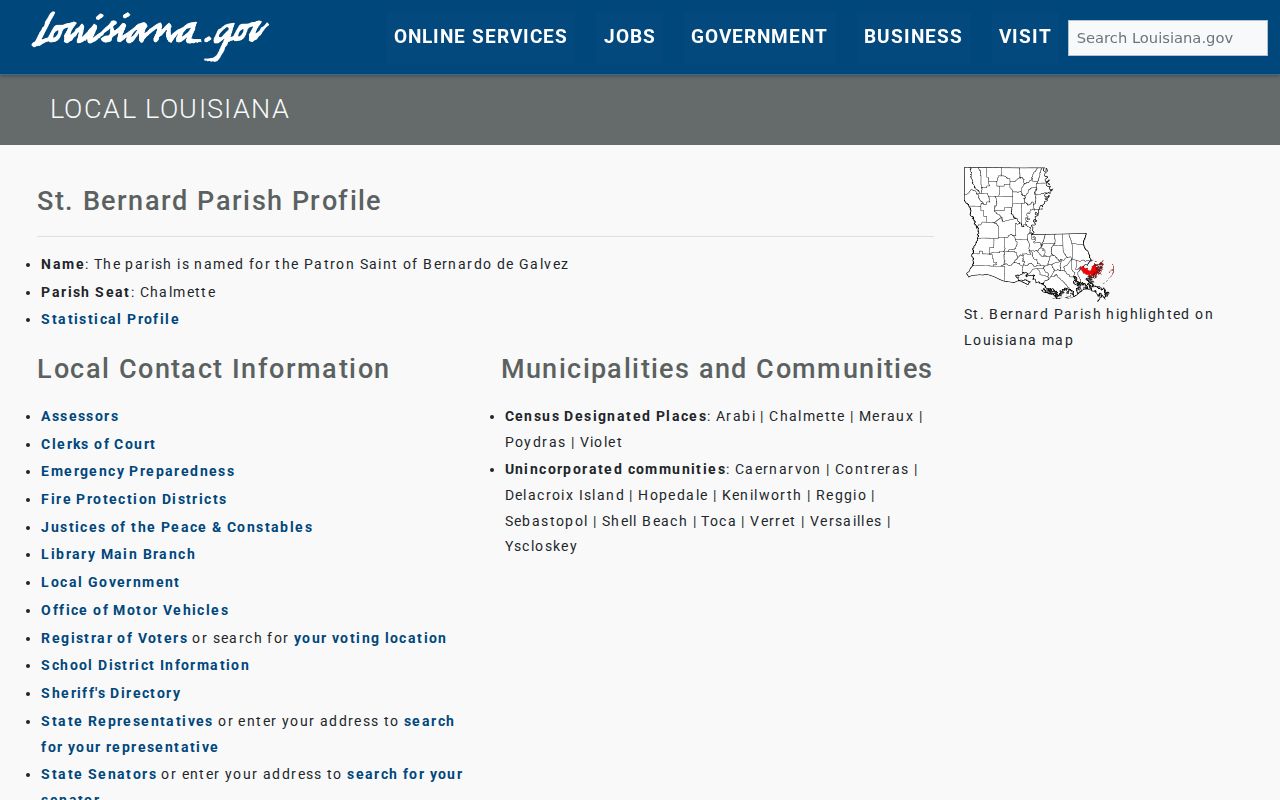
Meraux and Arabi are also census-designated communities. They do not have separate municipal police departments, city jails, or municipal criminal courts. Residents use the same parish-wide SBSO and 34th JDC chain.
Sealed, Expunged, and Restricted Records
Louisiana expungement removes a qualifying arrest or conviction record from ordinary public access without destroying it. Title XXXIV of the Code of Criminal Procedure controls eligibility and procedure. A practical St. Bernard filing starts by obtaining the record and disposition, checking eligibility, gathering agency identifiers, filing in the 34th JDC, serving the required agencies, and paying the statutory fees unless a waiver applies.
Article 971 states the remove-without-destroying rule. Article 973 preserves confidential access for law enforcement, criminal justice agencies, the person and counsel, courts for good cause, and specified bodies. Juvenile records are generally confidential under separate rules. Correcting a false fact is not the same process as expungement.
Local, State, and Federal Custody
St. Bernard Parish Prison covers local pretrial and parish custody. DPS&C directs statewide custody and supervision searches to LA VINE, which updates incarcerated, probation, and parole information on a daily cycle, and also offers a telephone locator at 225-383-4580. A sentence in the court record may be more complete than the limited public supervision entry.
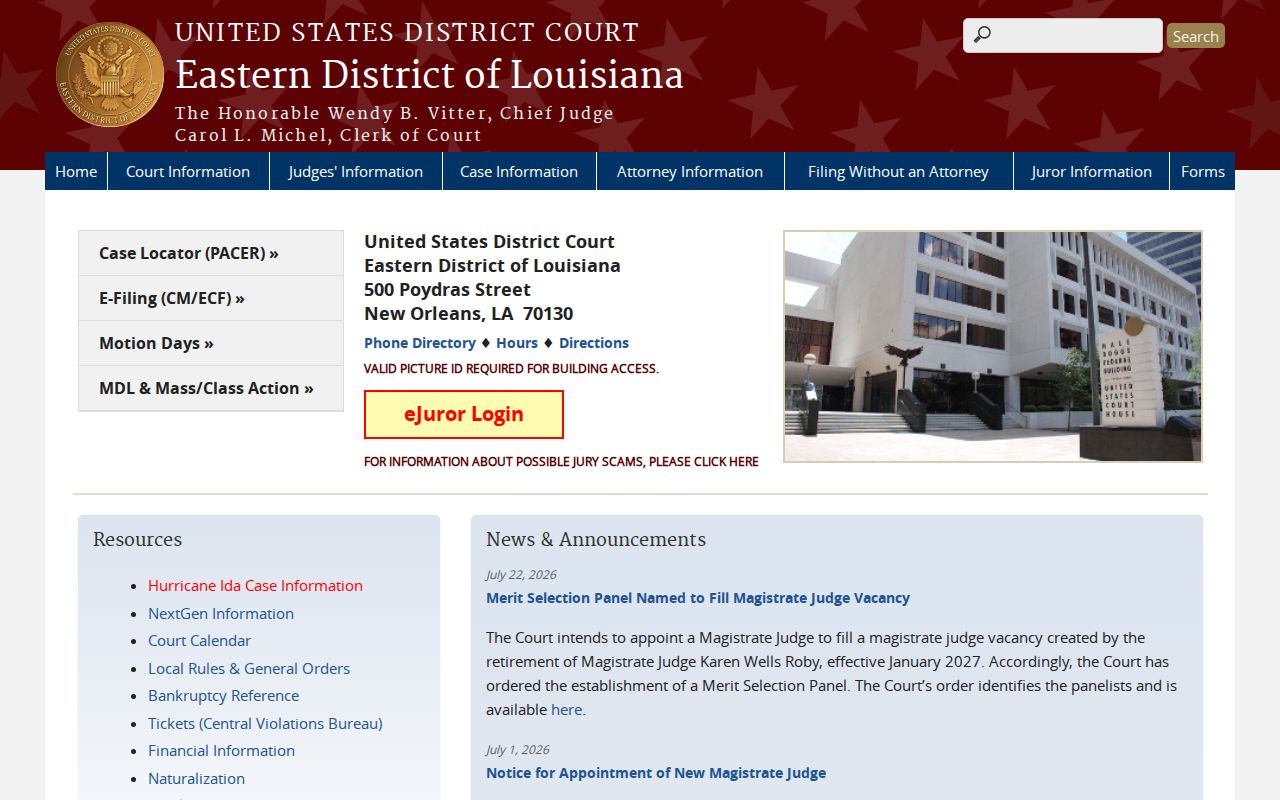
Federal matters use different systems. St. Bernard Parish lies in the Eastern District of Louisiana:
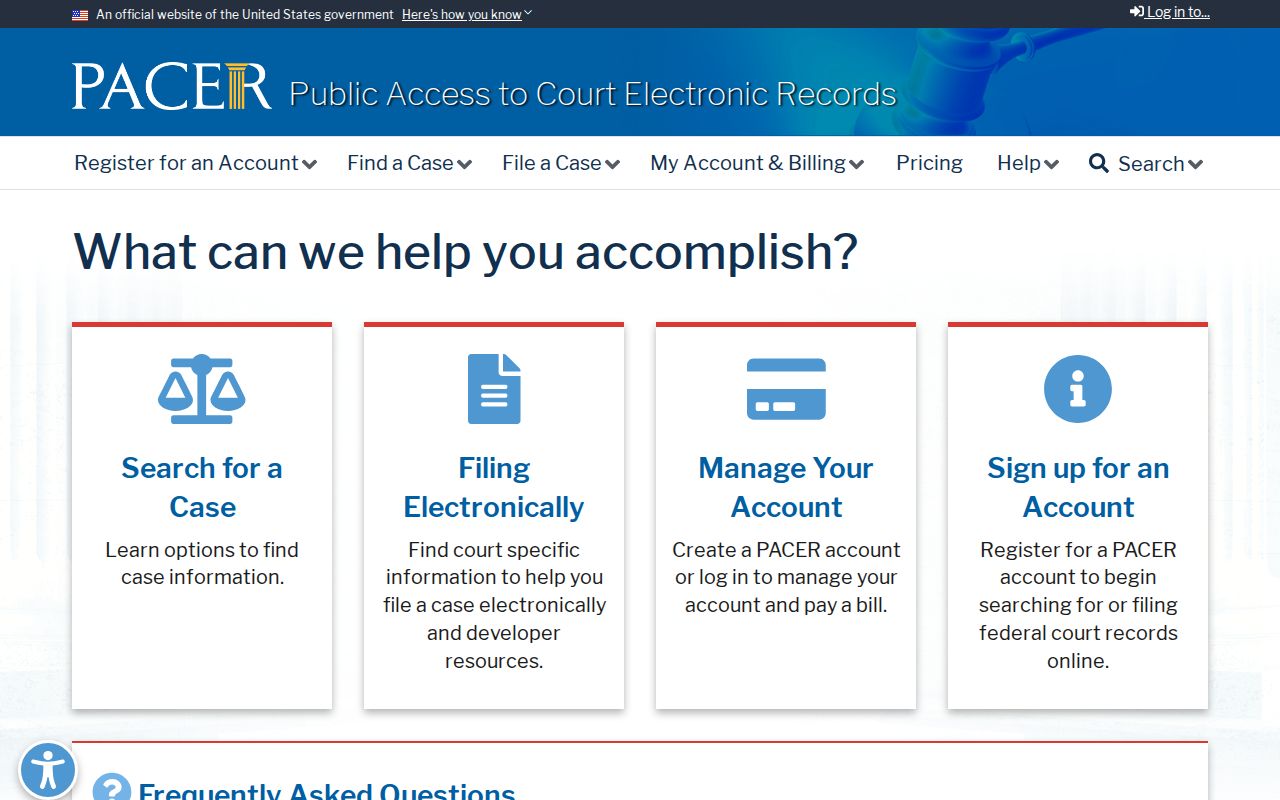
Federal filings are searched through PACER, whose interface separates specific-court and nationwide index searches:
A person in federal custody can be located through the Federal Bureau of Prisons Inmate Locator:
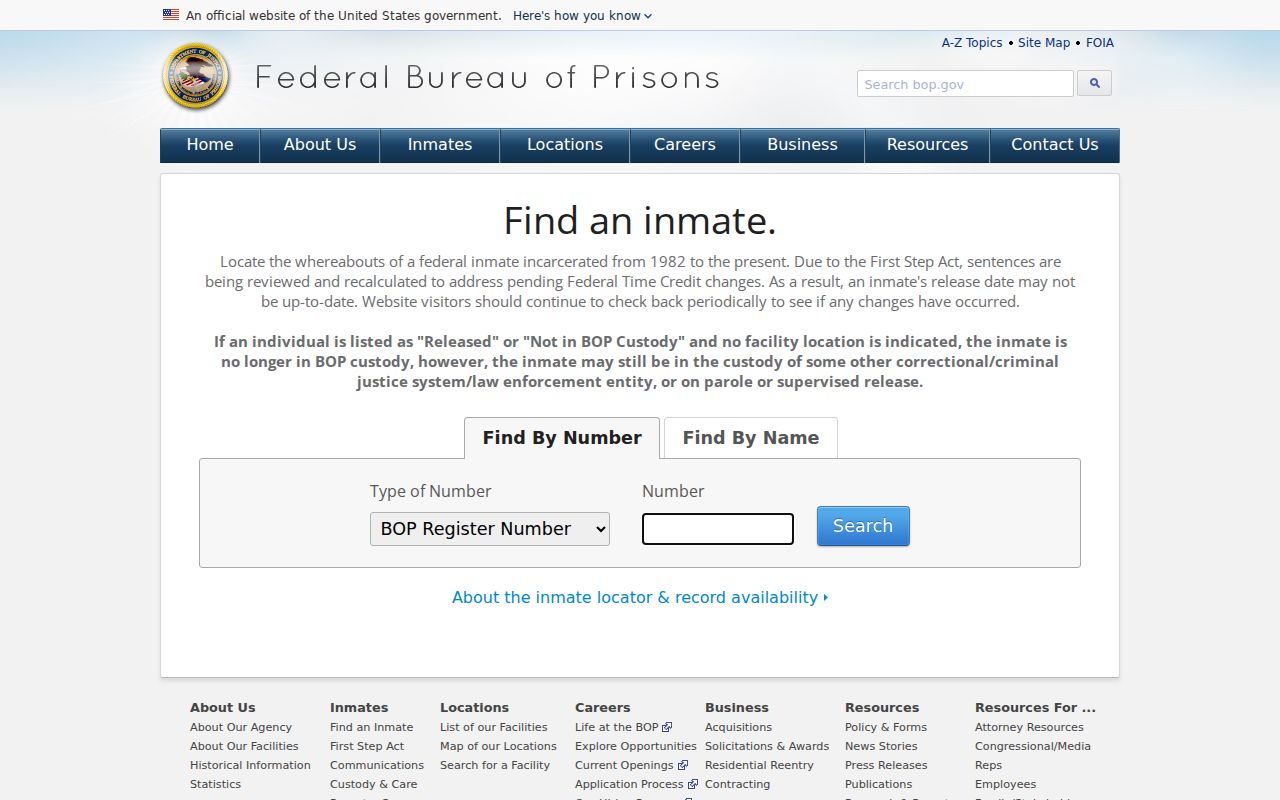
The BOP search accepts a federal register number or identifying name fields; it does not replace PACER's case docket.
Criminal Records by City in St. Bernard Parish
These community guides reflect the parish's three largest census-designated places. None is an incorporated city, so none maintains its own police department, city jail, or municipal criminal court. Each guide explains how the shared Sheriff, prison, Clerk, 34th JDC, and Louisiana systems apply at the community level.
Chalmette Criminal History
Parish seat and location of the main justice offices.
Meraux Criminal History
CDP served by parish-wide SBSO and 34th JDC records.
Arabi Criminal History
CDP whose criminal records remain with parish agencies.